Drawing in Transition
A Reading from Representation to Conversation
Yekta
Tehrani
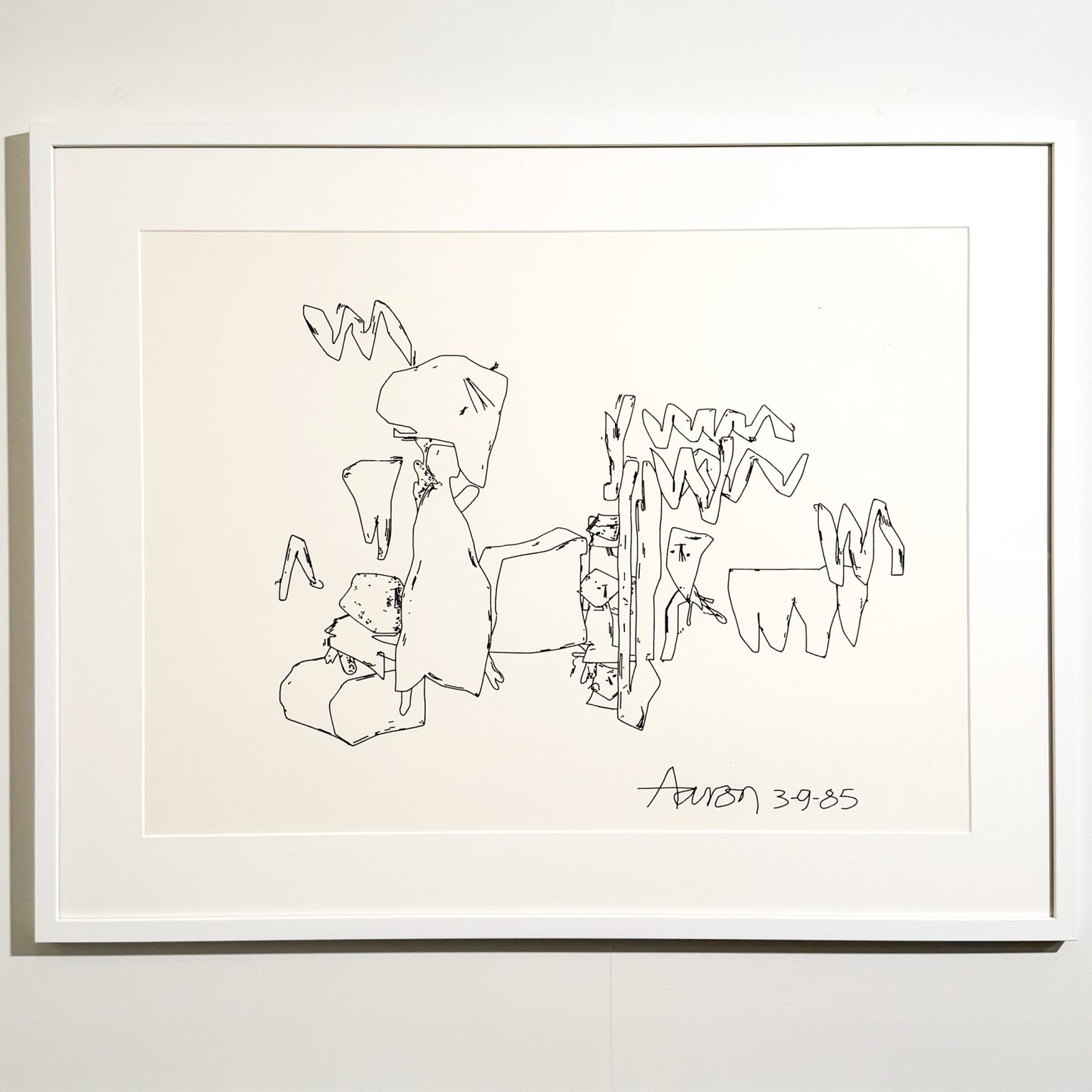
Harold Cohen, AARON at Tsukuba, #3 3-9-85, 1985. Plotter drawing in ink on paper. Photograph by the author. Courtesy of Gazelli Art House, London.
Supervision team
Francesca Dell’Aglio
Christopher Pierce
2025
~
Keywords
Drawing as Thinking, Generative Processes, Conversation, Distributed Authorship
Abstract
This research builds on the architectural theorist Marco Frascari’s understanding of the drawing as an act of thinking. Rather than an instruction or a device for built production, the drawing is examined as a continuous and open-ended process rather than a finished representation. It is never fixed. It remains open to change, transgression, and new meaning. In this sense it can be read in a state of in-betweenness, a state of transition that invites intervention and reinterpretation. The drawing becomes an active framework. It is a passage from immaterial thought into material output that resists fixed definition and welcomes an interruption that reconfigures what a drawing can be. Since the 1970s, technology has emerged as a tool for hybrid making and representation. The drawing has shifted not only in how it is produced but in its meaning and role within architecture and the visual arts. This research traces that shift through Harold Cohen. A celebrated abstract painter before his turn to computer science in the early 1970s, Cohen spent the rest of his career developing AARON, an AI system for autonomous drawing. His rule-based and code-driven systems anticipate contemporary generative AI without adopting its data-driven form. Yet they already distribute agency and authorship across the artist, the code, and the machine. In doing so they open the drawing into a structure of human and non-human collaboration. The research approaches this shift through four interconnected parameters: agency, authorship, collaboration, and correspondence. It proposes an alternative reading of the drawing’s transformation between 1970 and 2026, from rule-based to data-driven making. If the drawing is an act and an ongoing conversation between immaterial thought and material output, how might the outputs of generative AI be read as drawings rather than images? Drawing on archival research, comparative case studies, and interviews, this reading builds the foundation for new parameters by which the drawing can be defined.
Bio
Yekta Tehrani works at the intersection of art, architecture, and technology. Her research examines the transformation of drawing as an act of thinking, tracing the impact of technology on architectural and artistic practice from 1970 to 2026. Yekta holds a Bachelor of Environmental Design (Hons) from the University of British Columbia (UBC), MArch from UBC, and MArch in Architectural Design (Distinction) from the Bartlett School of Architecture at University College London, where she was awarded the BPro Thesis Design Award.
Contact
abolghasem-tehra@aaschool.ac.uk
LinkedIn, https://www.linkedin.com/in/yekta-tehrani/