Ground resistance and Assistance assemblages
Displacement and dispossession in Bajo Atrato
Nadia
Diviany
Mendez Guevara
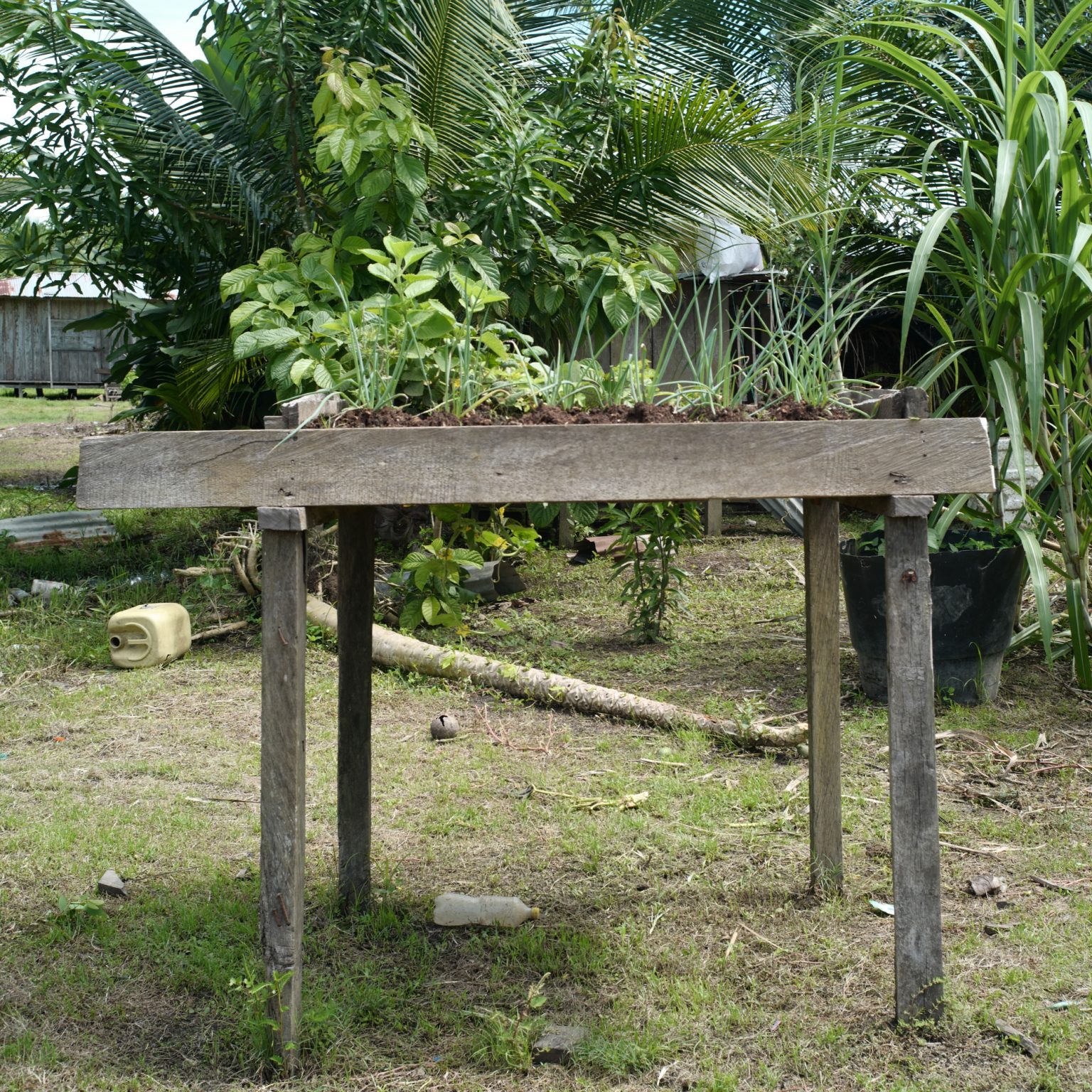
Azotea, Nueva Vida Self-Proclaimed Humanitarian Zone, Cacarica Basin, photograph, Nadia Méndez Guevara, PhD Architectural History, 2024. Azotea reconstructed after forced displacement as part of the self-managed return organised by CAVIDA, the community organisation founded to lead the return process following the 1997 forced expulsion.
Supervision team
Maria Shéhérazade Giudici
Pier Vittorio Aureli
2022
~
Keywords
Resistance, Ground, Assistance, Forced displacement, Dispossession
Abstract
Humanitarian assistance inscribes forced displacement within the logic of emergency: concealing its structural and historical causes and interrupting communities’ own political processes. In the Bajo Atrato-Darién, known as the best corner of America for its strategic position and extractive wealth, Afro-Colombian communities have resisted cyclical dispossession through spatial formations that contest those frameworks. This thesis calls that capacity ground resistance: the political dimension of territory, activated as a tactical mechanism when dispossession seeks to reduce it to resource. Working across the longue durée of colonial extraction and through the microhistories of specific spatial formations, the thesis argues resistance in the Colombian Pacific was not a response to the colonial order but its ground: formed through ecological knowledge carried across the Atlantic slave trade, reconfigured through coexistence with Indigenous communities, consolidated from adaptation into politicisation through five centuries of territorial co-agency. Ground resistance produces what this thesis calls assistance assemblages: hybrid configurations that emerge at the intersection of humanitarianism and environmental conservation, through which the Cacarica Basin communities organised a self-managed return in the midst of conflict. These assemblages contest the framing of forced displacement as temporary exception by reconnecting it with its structural and colonial causes, and exceed humanitarian frameworks from within by refusing the separation between human and environment on which conventional assistance is built. Reading these formations as architecture makes visible a spatial history of resistance the field has not yet seen. Ground resistance makes it legible and generates other ways of practising assistance from the ground up.
Bio
Nadia Méndez is an architect, urbanist and researcher. She holds degrees in architecture from Universidad de los Andes and in urban design from the Bartlett School of Architecture (UCL). She is a PhD candidate at the Architectural Association, where her research examines ground resistance and assistance assemblages as spatial formations through which Afro-Colombian communities have resisted cyclical displacement and dispossession in the Colombian Pacific. With over a decade of international practice, she co-founded Plano Negativo, advancing a Latin American approach to forensic architecture.
Contact
Mendez-Guevara@aaschool.ac.uk
nm@planonegativo.org
Practice, https://www.planonegativo.org/