Concrete Capital
Architecture of Apartments in Seoul, 1930-2030
Jang Hee
Lee
Supervision team
Maria Shéhérazade Giudici
TBC
2025
~
Keywords
Seoul, Korea, Apartment, Housing, Political Economy, Commons.
Abstract
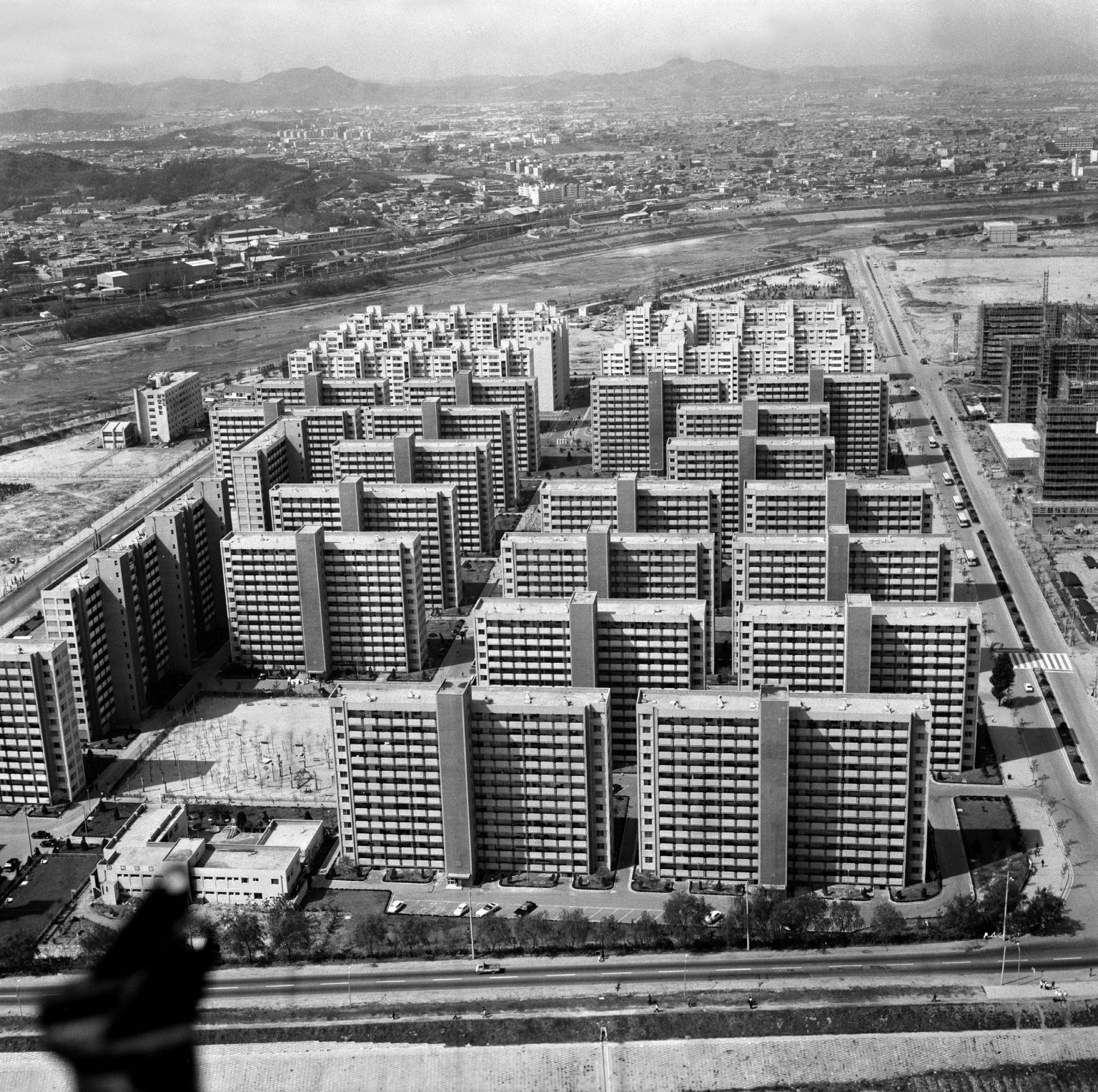
Visitors to South Korea are often struck by apartments dominating both urban and rural landscapes. This thesis asks how and why the apartment became the dominant housing type in Korea. Existing scholarship splits between formal analysis and political accounts, rarely connecting the two, and lacks a sustained Marxist reading of how architectural form mediates social reproduction. It also tends to treat the apartment as a post-1960s phenomenon, overlooking its colonial origins. This thesis argues the Korean apartment is not a neutral outcome of modernisation or Western imitation. Rather, it is a typological instrument through which successive regimes – colonial, developmental and neoliberal – organised governance, social reproduction and capital accumulation. The apartment functions as both a document and an agent of these transformations, producing new capitalist social relations of land, labour and capital. Following a chronological arc from 1930 to the present, the thesis is structured in four chapters and an epilogue. Chapter 1 examines the colonial period, framing early Korean apartments through Marx’s primitive accumulation. Chapter 2 addresses the military authoritarian regime of Park Chung-hee, revealing through the Mapo Apartment how mass housing served as a politicised instrument for managing exploitation, stabilising labour reproduction, and fuelling construction monopolies. Chapter 3 traces exponential apartment growth through Jamsil and the New Towns, exposing mass spatial production as counter-revolution against an ascendant labour movement. Chapter 4 argues that the 1997 financial crisis catalysed high-rise towers and accelerated redevelopment, revisiting primitive accumulation as an ongoing process that hyper-commodified the apartment into a core financial asset. The Epilogue addresses social precarity and new political struggles over housing post-Covid. Throughout, typological research serves as both analytical and projective design tool.
Bio
Jang Hee Lee is an ARB-registered architect and researcher whose work explores the intersections of architecture, the city and political economy. He graduated from Yonsei University and the Architectural Association (AA) with commendation, and is currently a PhD candidate at the AA. He has led design-research workshops at the AA, AAVS Seoul, Royal Academy of Fine Arts Antwerp, University of Antwerp, Leeds Beckett University and Kaywon University of Art and Design. He also serves as an architect on the Construction Committee of Dhamma Padhāna, a Vipassana meditation centre in Hereford.
Contact
janghee.lee@aaschool.ac.uk