Beyond Figure-Ground
The Process Of Prioritisation In Representing Urban Form
Aylin
Tarlan
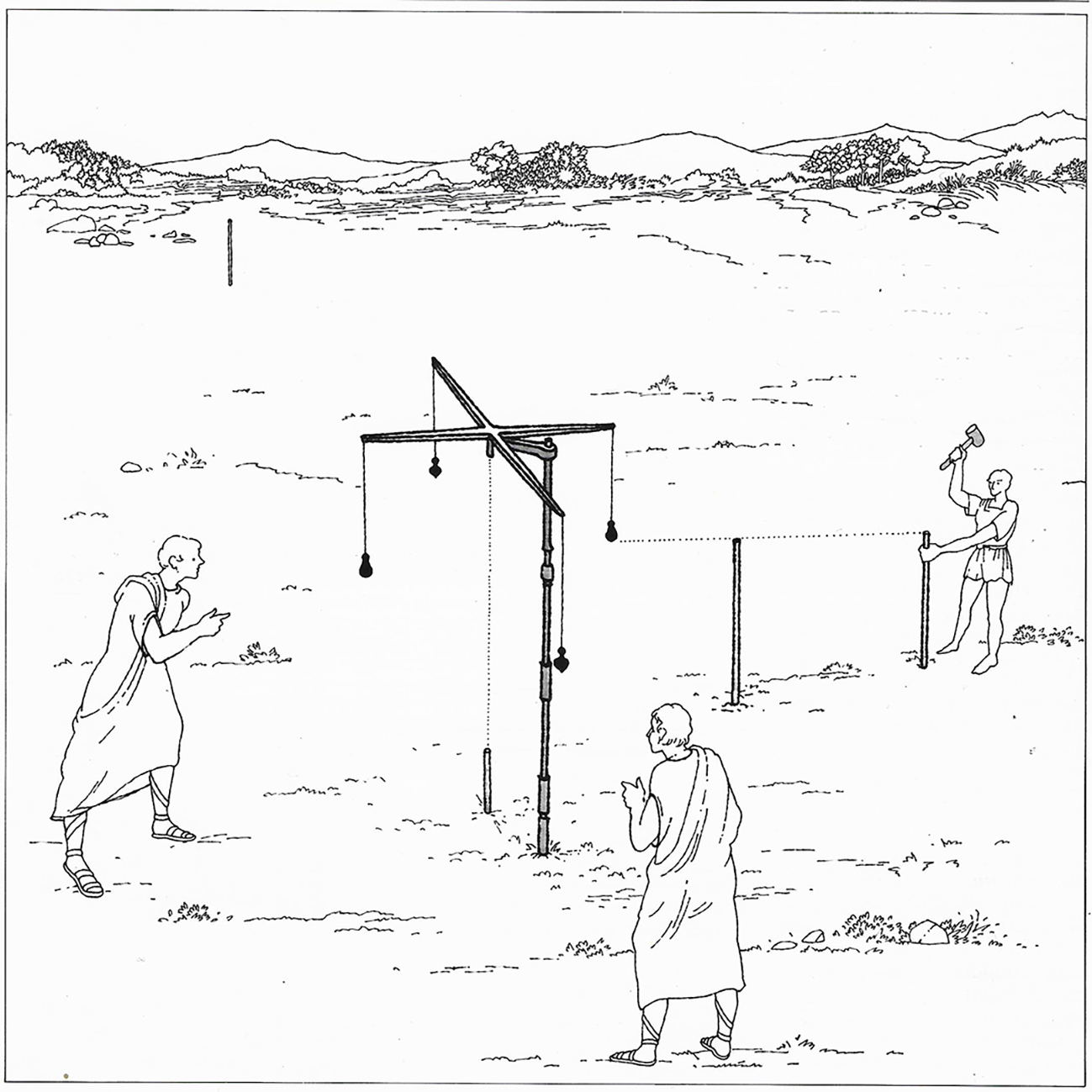
G. Moscara, Surveyors at Work, 2003. Drawing reproduced from Misurare la Terra: Centurazione e Coloni nel Mondo Romano.
Supervision team
Pier Vittorio Aureli
Maria Shéhérazade Giudici
2021
~
2025
Keywords
geographic information systems, urban representation, prioritisation
Abstract
This thesis studies the position of figure and ground in urban representation, from Roman urban survey plans to contemporary digital cartography. It begins by investigating the origins of the terms figure and ground in fields such as optics, perception, Gestalt psychology, art and early representations of cities. It then unfolds both genealogically and thematically through a series of case studies of different representations of urban form.The thesis problematises the process of prioritising information during the production of urban form, the object through which figure-ground can be directly assessed. This question becomes increasingly relevant in digital cartography, where the organisation of data relies on software and where the processes of foregrounding and backgrounding remain unsettled. The word forma was first used to refer to an object during the Roman centuria. Forma, a document inscribed on a bronze tablet, recorded the subdivision and privatisation of land during colonisation. It was a process of recording land ownership carried out by surveyors and marked an early moment in the representation of urban form.To further investigate this phenomenon, the thesis analyses a series of examples ranging from the Forma Urbis and the maps of Bufalini and Nolli to the Cassini maps. These case studies explore the increasing scientific methods and technologies used in the production of urban form, showing how cartographic abstraction made land ownership legible as data. The design component follows this investigation by examining digitally produced maps, both as documentation of current mapping processes and as a project that speculates on contemporary forms of data prioritisation.
Bio
Aylin Tarlan is an architect, researcher and educator. She studied architecture at the University of Florence and the École Nationale Supérieure d’Architecture de Paris-Belleville, and holds a Master of Architecture from Pratt Institute. She has worked in New York, Istanbul, Miami and Cannes, and founded her own practice in 2012. She has taught theory and design studio at Bilgi University in Istanbul and later completed her PhD by Design at the Architectural Association.
Contact