Staging Facts on the Ground
On the Historical Role of Built Objects as Markers of Imperial-Colonial Expansion
Lukas
Matthias
Pauer
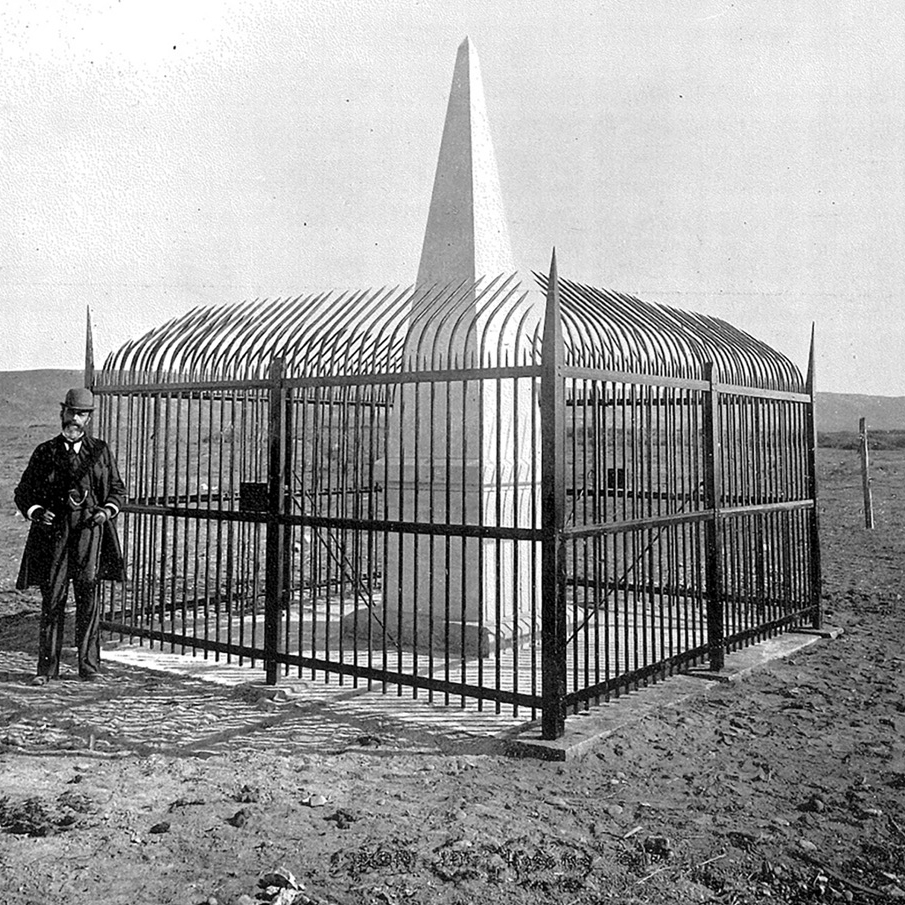
José María Blanco, Vistas de los Monumentos a lo Largo de la Línea Divisoria entre México y los Estados Unidos de El Paso al Pacífico, 1901.
Supervision team
Pier Vittorio Aureli
Thanos Zartaloudis
2019
~
2023
Keywords
human territoriality, human geography, political geography, soverignty marker, power projection
Abstract
This research critically examines built objects as evidence of the projection of power, authority and influence. More specifically, the dissertation studies how imperial-colonial expansion has been performed architecturally throughout history.There remains a lack of general understanding of imperial-colonial violence as a pervasive and ongoing condition around the world. Not to recognise its workings in the built environment is itself a risk. In response, I seek to establish a working language by offering an account of architecture as a world-making device for the production of political imaginaries that legitimise claims to sovereignty. I argue that, throughout the history of imperial-colonial expansion, the acquisition of sovereignty has depended on its practical realisation on the ground.Structuring the dissertation, I inventory and categorise built objects that have been instrumental in acquiring authority and influence over people and land. The first chapter looks at ancient Hellenic scene buildings, sacred barriers and Roman military standards, examining the scenographic techniques through which claims to governance were made. The second chapter analyses Eastern traveller inns, nation houses and Western trade factories along medieval trade routes as extraterritorial techniques of power. The third chapter turns to French semaphore towers, timeball towers and British telegraph poles, showing how geodetic techniques operated along modern signal lines. The fourth examines quarantine, detention and prescreening facilities as filtrational techniques of influence along recent transit corridors.The dissertation follows the Euro- and Western hegemonic lineage of techniques it seeks to expose and deconstruct. It argues that sovereignty is not merely the domain of jurists and cartographers. Architects, too, have played a key role in linking sovereignty to the ground through material markers. Sovereignty, in this sense, is not without its markers.
Bio
Lukas Pauer is a licensed architect, urbanist and educator, and Founding Director of the Vertical Geopolitics Lab, an investigative practice examining hidden systems within the built environment. He teaches landscape architecture at the University of Edinburgh and completed his PhD in Architectural Design at the Architectural Association. He holds an MAUD from Harvard University and an MSc Arch from ETH Zürich. His work focuses on the political geography of urban form and the architectural legacy of imperial and colonial expansion.
Contact